How Dreavie works: from dream to analysis
By Noah SoticekPublished
Here is how Dreavie works: you write down your dream, answer up to five short questions and get an analysis that connects the dream to your life. One analysis a month is free. This guide walks through every step with a real example, from the dream field on the home page to the finished result. If you want to know what Dreavie is first, read What is Dreavie?
How do I write down my dream?
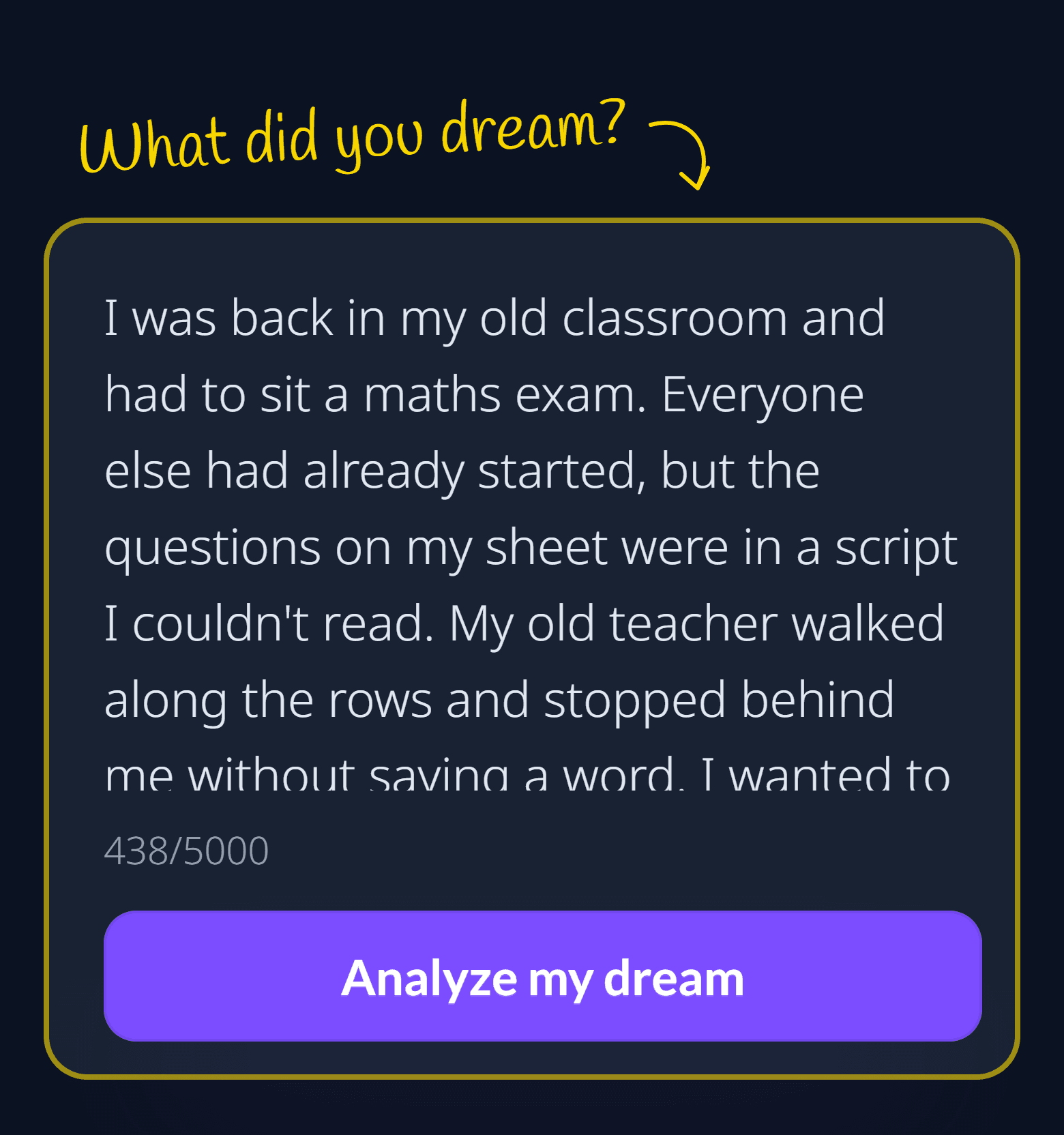
Type your dream into the field on the home page, the way you remember it. Fragments are fine, spelling doesn’t matter, and you have room for 5,000 characters.
Detail helps. When Dreavie reads a dream, it looks at the order of the scenes, who does what, what is missing and which details don’t fit. So write “my old teacher stopped behind me without saying a word” instead of “there was a teacher”.
For this guide we used a dream many people know: back in the old classroom, a maths exam, and the questions are in a script you can’t read.
Which questions does Dreavie ask, and why?
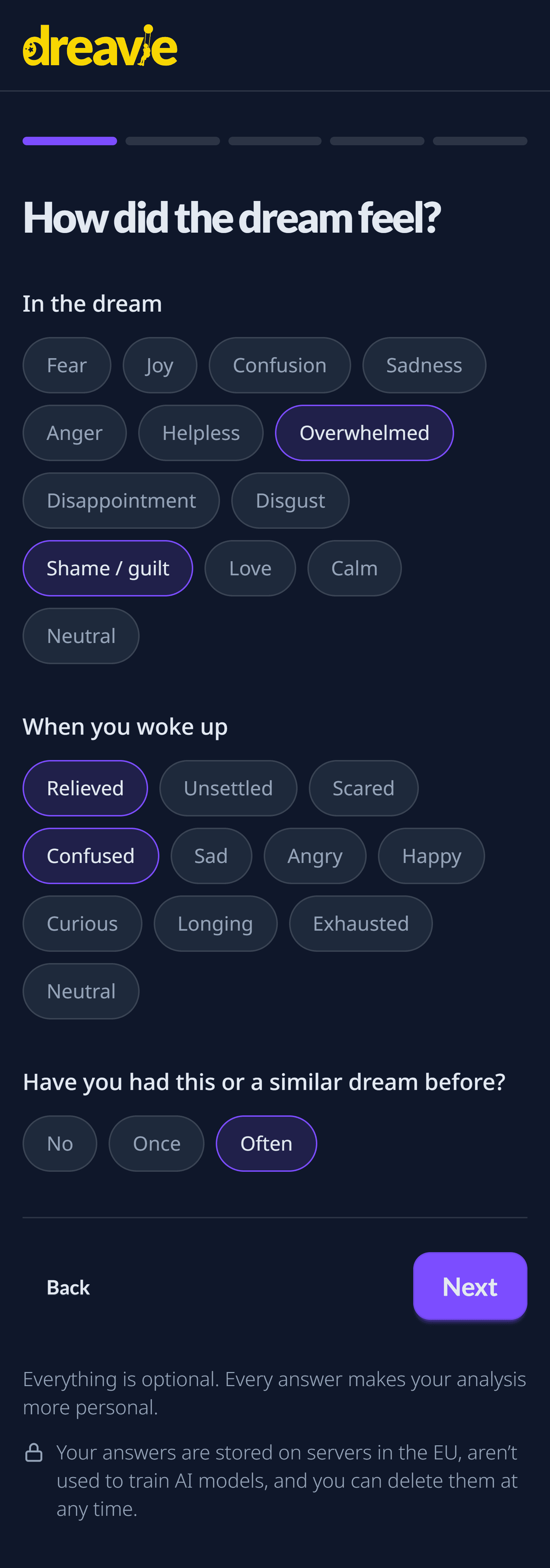
After the dream, Dreavie asks questions on five short screens, because the same dream can mean different things depending on what is going on in your life. Every question is optional, and you can skip any screen.
- How did the dream feel? Feelings in the dream, feelings when you woke up, and whether you have had the dream before.
- Your life right now. One or two sentences about what is on your mind, plus topics to tap such as work, family or stress.
- The dream and your real life. Who from your life appears in the dream, and whether the dream is linked to something that really happened.
- About you. Relationship status, age and something from your past that still occupies you. Dreavie asks this once, so from your second dream on there are four screens.
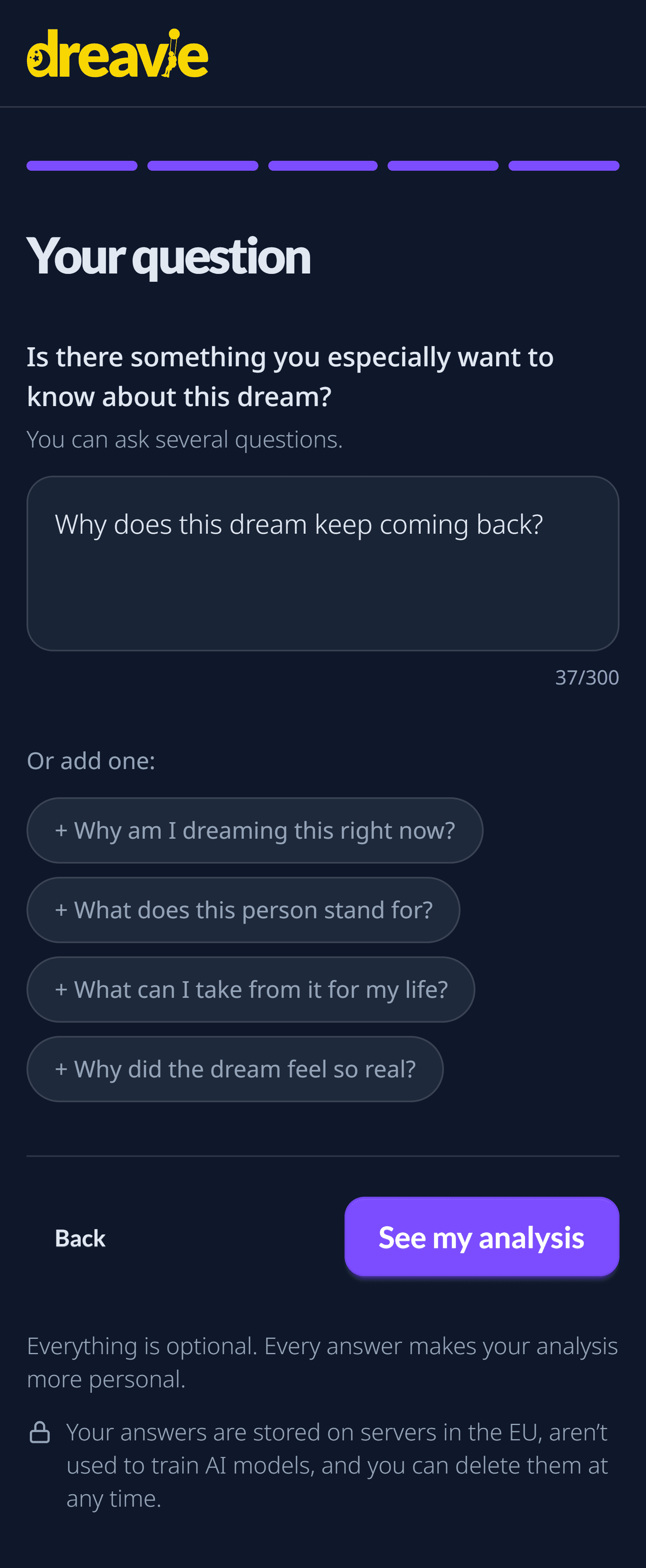
- Your question. What you especially want to know about this dream.
How do my answers change the analysis?
The quality of the analysis depends heavily on your answers. If you skip every question, Dreavie has only the dream text and the reading stays general. The more precisely you answer, the more personal and accurate it gets, because your answers decide which of several possible readings fits you.
Our example shows this in three places:
- The answer “In three weeks I’ll be leading a project of my own for the first time” comes back in the section “Connection to your life”. Without it, the dream would have stayed a generic exam dream.
- We described the teacher as “strict but fair”. The analysis picks that up: in the dream he doesn’t criticise anyone, so the shame may come from what you expect him to think.
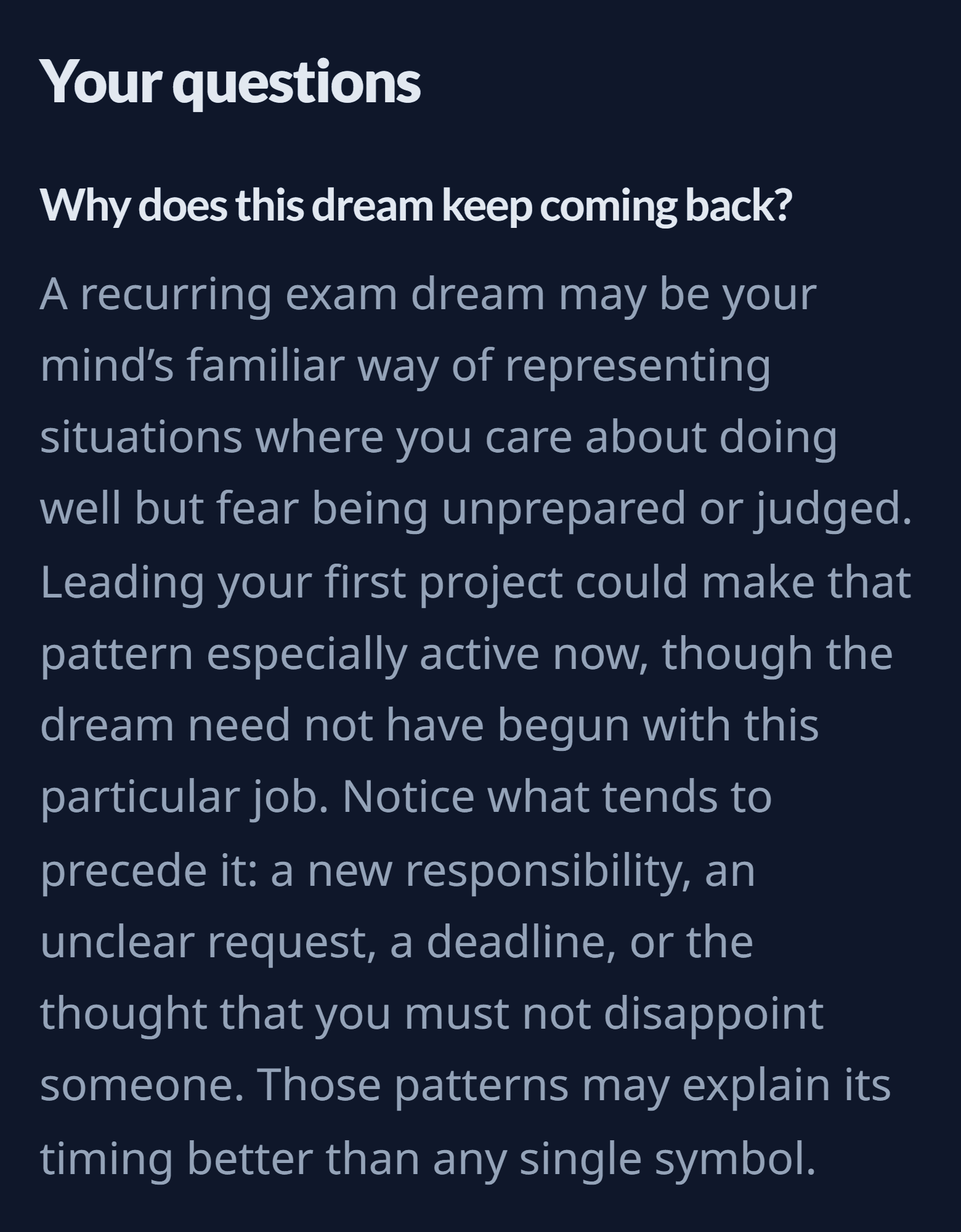
- We tapped “Often” and asked about it, so the analysis explains what the repetition may mean.
Your own question gets its own section. If you ask several, Dreavie answers each one separately.
What do I get for free?
You get one complete analysis every calendar month for free. It is the same analysis as the paid one.
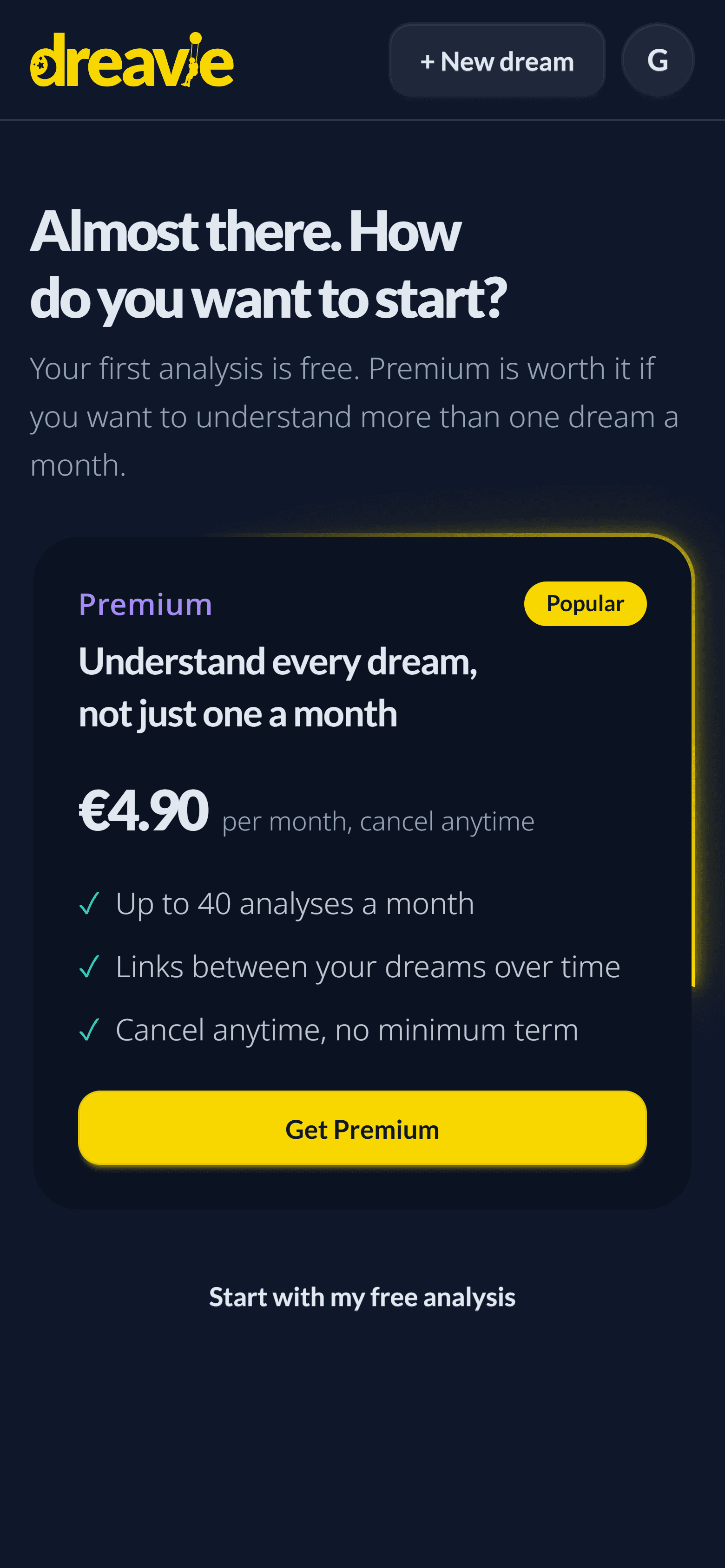
Before the analysis you sign in, with Google or with a six-digit code sent to your email. You don’t need a password. Dreavie then asks once whether you want to start with your free analysis or with Premium.
If an analysis fails for technical reasons, it doesn’t use up your free one.
What happens while Dreavie analyses my dream?
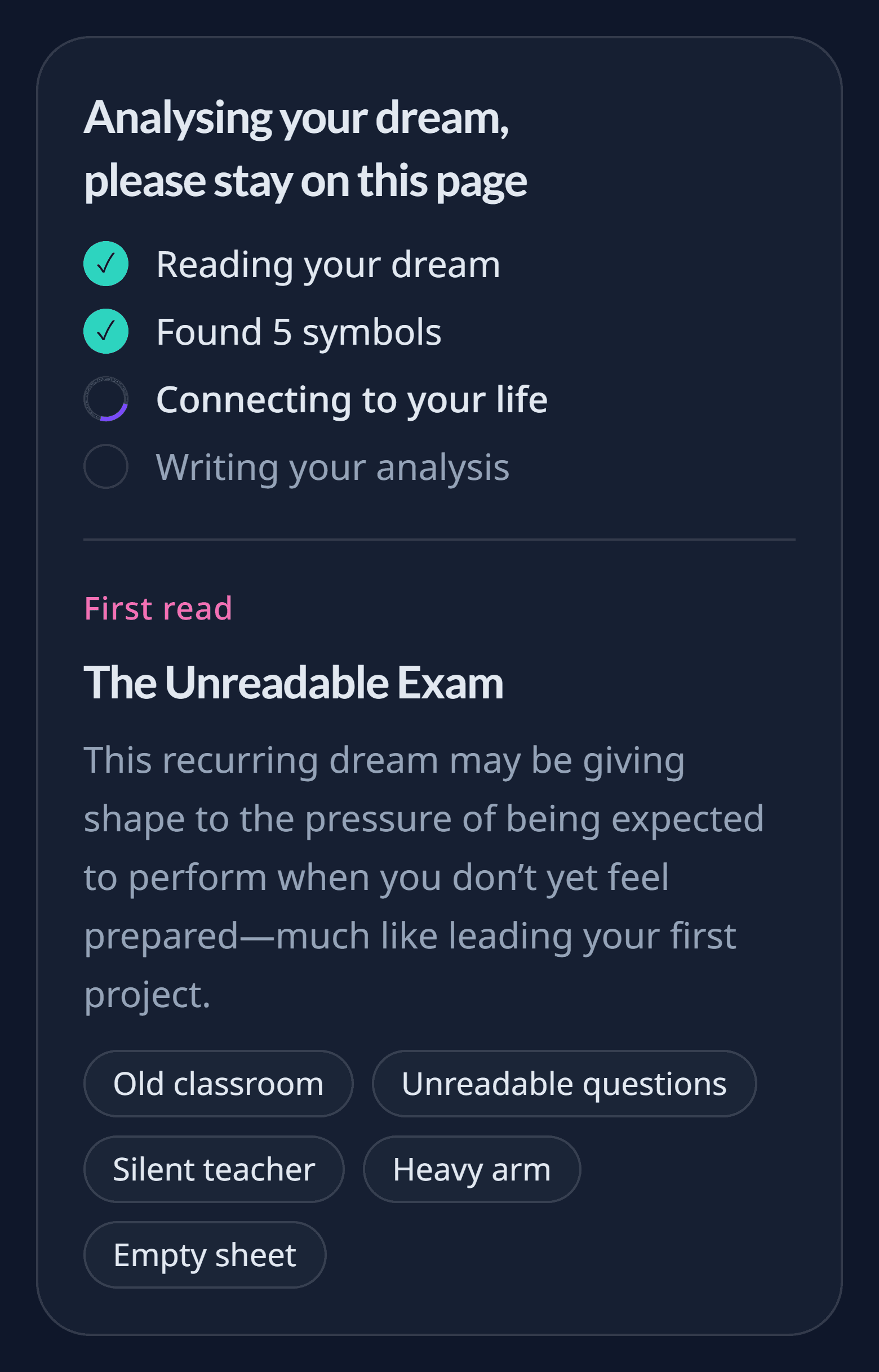
Dreavie works in two steps: first a short first read with a title, the core theme and the main symbols, then the full analysis. You see the first read while the rest is still being written.
In our example the first read appeared after 8 seconds and the finished analysis after 40 seconds.
What is in the analysis?
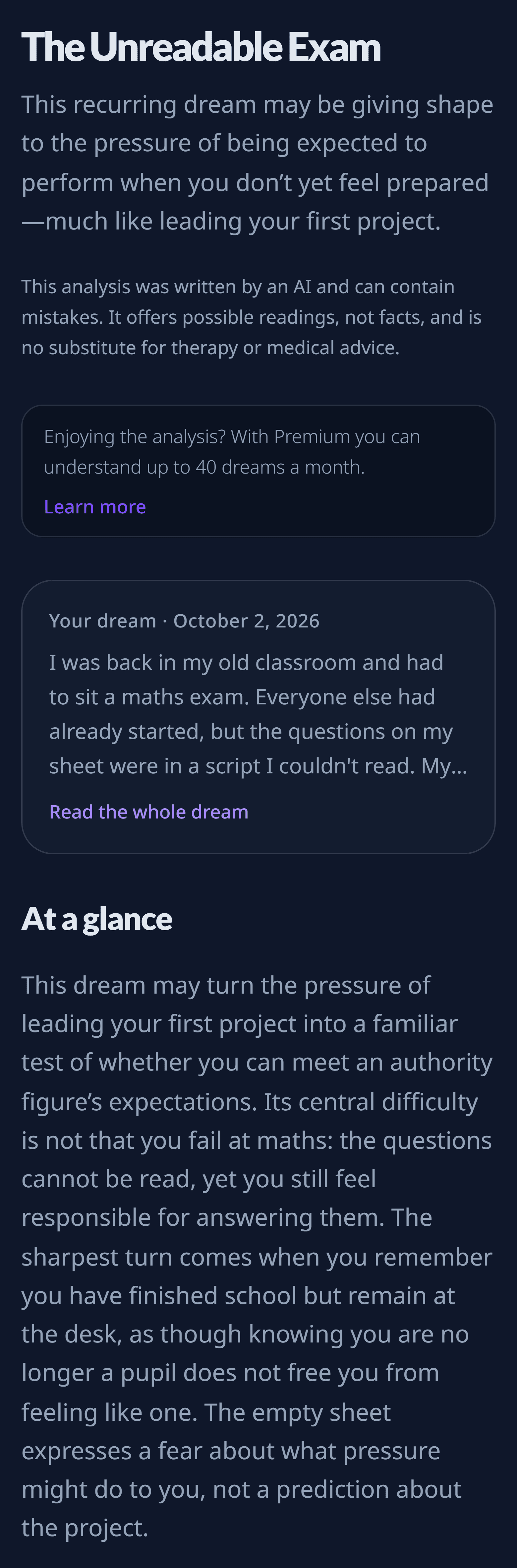
The analysis has up to ten parts, always in the same order. Our example analysis is about 1,400 words long.
| Part | What it tells you |
|---|---|
| Title and core theme | What the dream may be about, in one sentence |
| At a glance | The central reading and how the scenes connect |
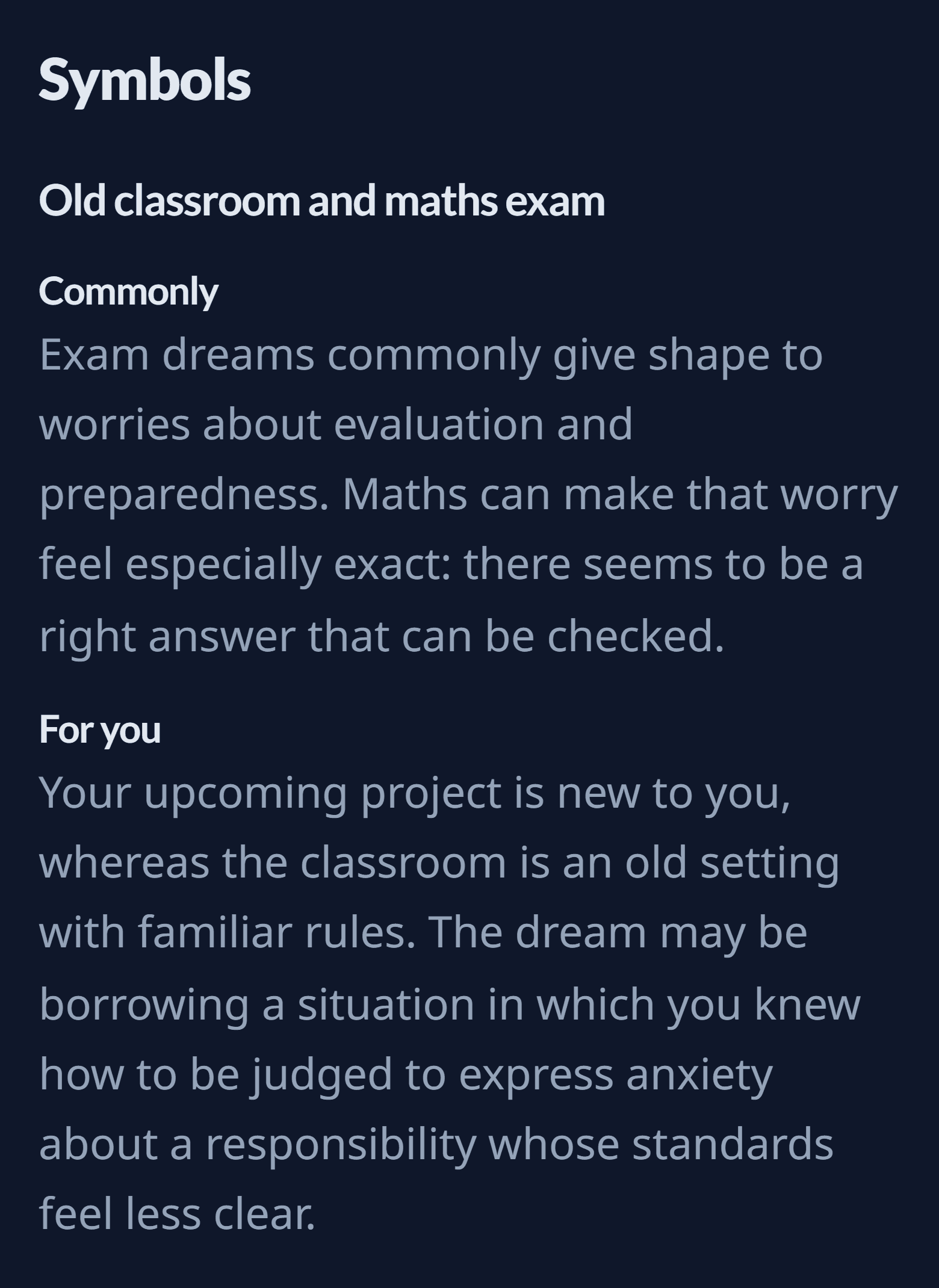
| Symbols | 4 to 7 images or figures, each with “Commonly” and “For you” |
| Feelings | How the feelings move from the dream to waking up |
| Connection to your life | How the dream may relate to your situation |
| Links to your earlier dreams | Only appears when there is a specific link to an earlier dream |
| Your questions | Answers to what you asked. Left out if you asked nothing |
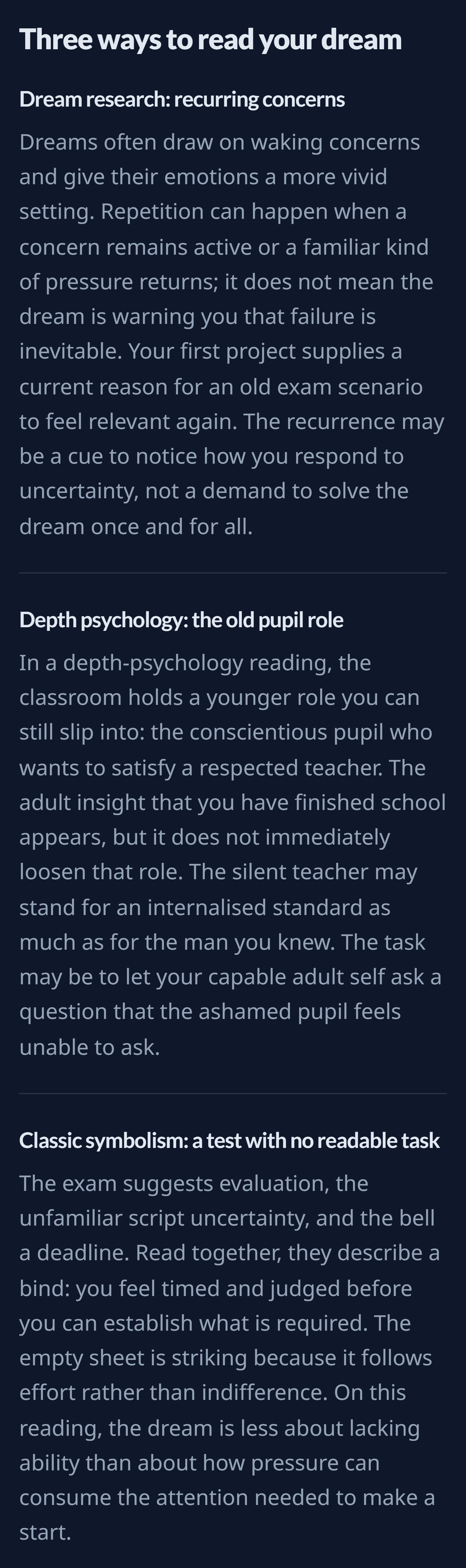
| Three ways to read your dream | Three different readings of the whole dream |
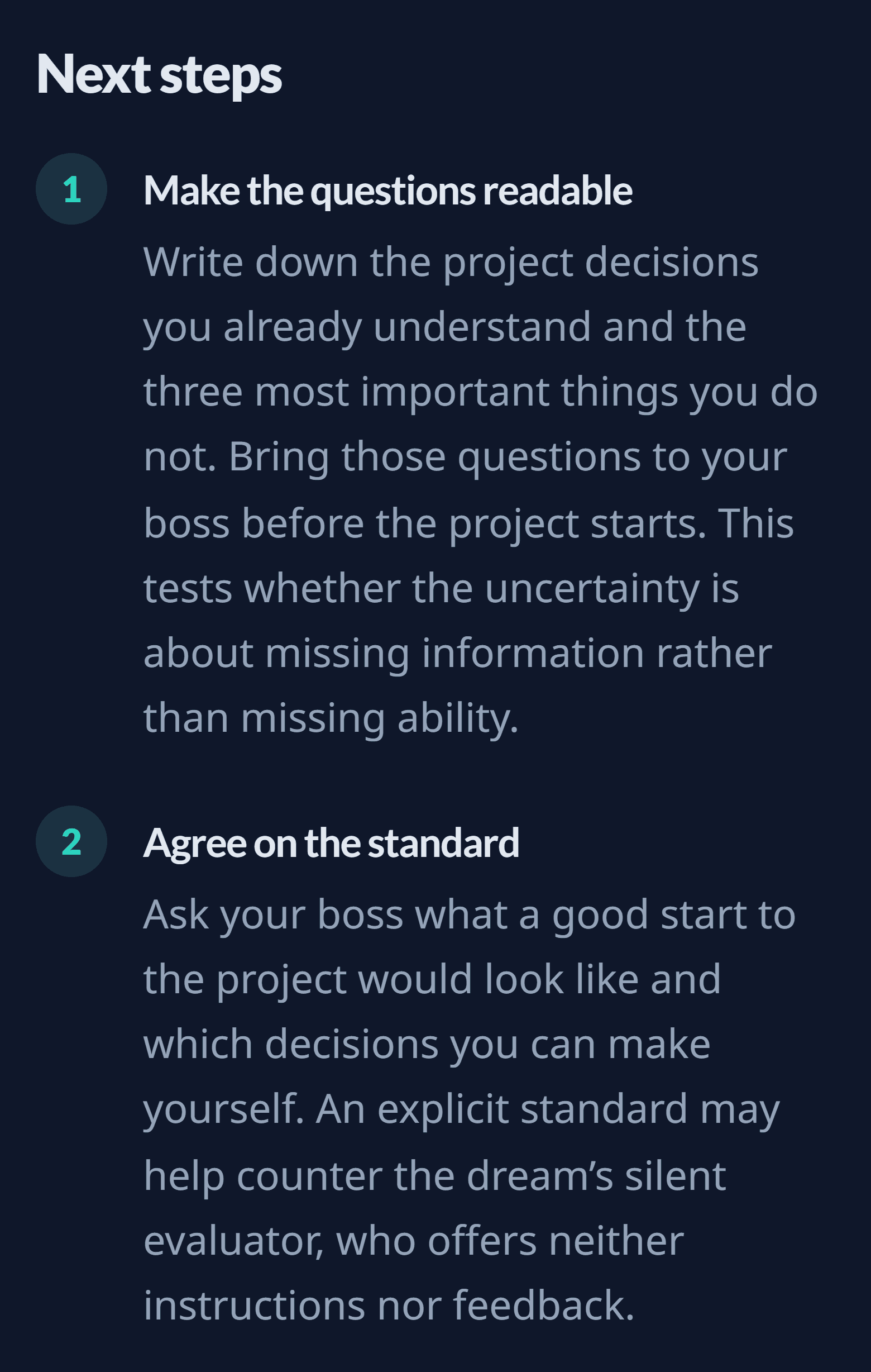
| Next steps | 4 to 5 concrete things you can do |
| Questions to think about | 3 to 4 questions to ask yourself |
How do I read the symbols?
Each symbol has two paragraphs. “Commonly” says what the image tends to stand for. “For you” relates it to what you wrote, and it is the part that matters more.
What are the three ways to read my dream?
They are three different readings of the whole dream. In our example: dream research, depth psychology and classic symbolism. They don’t have to agree. Take the one that rings true for you.
What do I do with the next steps?
The next steps are suggestions for your daily life that fit this one dream. The first one in our example: write down the three most important things you don’t yet know about the project and take them to your boss. Pick one step, not all five.
What can’t the analysis tell me?
The analysis is not therapy, not a diagnosis and not medical advice. It is written by an AI and can contain mistakes.
Three more limits:
- It offers possibilities, not the truth. A dream has more than one reading. Only you can judge whether a reading fits.
- It doesn’t predict anything. Dreavie doesn’t treat dreams as omens. Our example says outright that the empty sheet is not a prediction about the project.
- It only knows what you write. Dreavie knows nothing about you apart from your dream, your answers and short summaries of your earlier analyses.
If dreams or feelings weigh heavily on you, please talk to a doctor or a therapist. If your text suggests an acute crisis, Dreavie shows crisis line numbers above the analysis. Don’t rely on that being detected every time.
What do the paid plans add, and who needs them?
The paid plans add more analyses, not a better one. If a dream is on your mind only now and then, the free analysis is enough.
| Plan | Price | Analyses | Fits if … |
|---|---|---|---|
| Free | €0 | 1 per calendar month | a dream stays with you now and then |
| Single analysis | €2.90, one-time | 1 more, never expires | your free analysis is used and a dream can’t wait |
| Premium (subscription) | €4.90 a month | Meant as unlimited, currently up to 40 a month | you dream a lot or one dream keeps coming back |
The single analysis is a one-time payment with no subscription. You can cancel the subscription every month. All prices include VAT and are also listed in the pricing overview.
From your second analysed dream on, Dreavie takes short summaries of your latest dreams into account. That is why Premium pays off most for recurring dreams: the analysis can then show what changes from one dream to the next.
Frequently asked questions
Can AI interpret dreams?
Yes, if it knows enough about you. An AI knows what dream images commonly stand for and what dream research and psychology say about dreams. Which reading fits you depends on your context: your feelings, the people in the dream, your current situation. That is why Dreavie asks about them before it interprets.
Research supports this. In a 2026 study from Swansea University, 30 people rated AI dream interpretations that took their waking life into account as thorough and as very or moderately accurate. A conversation with a therapist went deeper in the same study.
Can’t I use ChatGPT for dream interpretation?
ChatGPT does a lot of things. Dreavie does one thing and does it thoroughly: interpret your dream. Five things you only get here:
- A reading that is about you. Dreavie asks for exactly what makes a reading personal: your feelings, the people in the dream, what is on your mind right now. You don’t have to build a prompt or know which context matters.
- An AI that specialises in dream interpretation. It reads your dream like an experienced dream analyst with a background in psychology: with findings from dream research, depth psychology after Jung and classic dream symbolism. It treats your dream as one connected story instead of looking up single symbols.
- Dreavie gets to know you better with every dream. What you shared about yourself and what your latest dreams showed goes into every new analysis. You see which themes come back and what changes, without explaining anything twice.
- You know what to do afterwards. Every analysis gets to the point of the dream, gives you three readings to compare and ends with four to five concrete steps for your daily life.
- Your dreams stay private. Dreams are among the most personal things you write down. With Dreavie they are stored on servers in the EU, aren’t used to train AI models, and you can delete them at any time.
Trying it costs nothing: one complete analysis a month is free.
Do I need an account?
Yes. You can enter the dream and answer the questions without an account. For the analysis you sign in with Google or an email code.
What happens to my data?
Your dreams and answers are stored on servers in the EU and aren’t used to train AI models. You delete single dreams on the dream page and your whole account in the account settings.
Can I read my analysis again later?
Yes. After signing in, all your dreams and analyses are under “My dreams” until you delete them.